AI Driven Analytics Tools

AI Driven Analytics Tools — independent reviews, comparisons, pricing and step-by-step guides on Aizhi.

  • Concept mining

    Concept mining

    Concept mining is an activity that results in the extraction of concepts from artifacts. Solutions to the task typically involve aspects of artificial intelligence and statistics, such as data mining and text mining. Because artifacts are typically a loosely structured sequence of words and other symbols (rather than concepts), the problem is nontrivial, but it can provide powerful insights into the meaning, provenance and similarity of documents. == Methods == Traditionally, the conversion of words to concepts has been performed using a thesaurus, and for computational techniques the tendency is to do the same. The thesauri used are either specially created for the task, or a pre-existing language model, usually related to Princeton's WordNet. The mappings of words to concepts are often ambiguous. Typically each word in a given language will relate to several possible concepts. Humans use context to disambiguate the various meanings of a given piece of text, where available machine translation systems cannot easily infer context. For the purposes of concept mining, however, these ambiguities tend to be less important than they are with machine translation, for in large documents the ambiguities tend to even out, much as is the case with text mining. There are many techniques for disambiguation that may be used. Examples are linguistic analysis of the text and the use of word and concept association frequency information that may be inferred from large text corpora. Recently, techniques that base on semantic similarity between the possible concepts and the context have appeared and gained interest in the scientific community. == Applications == === Detecting and indexing similar documents in large corpora === One of the spin-offs of calculating document statistics in the concept domain, rather than the word domain, is that concepts form natural tree structures based on hypernymy and meronymy. These structures can be used to generate simple tree membership statistics, that can be used to locate any document in a Euclidean concept space. If the size of a document is also considered as another dimension of this space then an extremely efficient indexing system can be created. This technique is currently in commercial use locating similar legal documents in a 2.5 million document corpus. === Clustering documents by topic === Standard numeric clustering techniques may be used in "concept space" as described above to locate and index documents by the inferred topic. These are numerically far more efficient than their text mining cousins, and tend to behave more intuitively, in that they map better to the similarity measures a human would generate.

    Read more →
  • Avid DS

    Avid DS

    Avid DS (which was called Avid DS Nitris until early 2008) is a high-end offline and finishing system comprising a non-linear editing system and visual effects software. It was developed by Softimage (this company was owned by Microsoft at the time of DS v1.0's launch before being acquired from Microsoft by Avid Technology, Inc. shortly thereafter) in Montreal. DS was discontinued on September 30, 2013 with support ending on the same date the following year. == Software == DS was called ‘Digital Studio’ in development. It was envisioned to be a complete platform for video/audio work. The first previews of the system were on the SGI platform, but this version was never released. The system was rewritten on Windows NT with different video hardware platforms (Matrox DigiSuite or Play Trinity running on a NetPower system) before the final system was released on Intergraph/StudioZ hardware in January 1998. After its acquisition by Avid, DS was always positioned as a high end video finishing tool. However, many users found it to be uniquely soup-to-nuts in its capabilities. From version 1.0 of the product, it competed with products like Autodesk Smoke, Quantel and Avid Symphony. The toolset in DS offered video timeline editing, an object-oriented vector-based paint tool, 2D layer compositing, sample based audio and starting with version 3.01 of the product, a 3D environment. Originally, a subset of the Softimage|XSI 3D software was planned to become part of the DS toolset, both were built on the same software foundation, but over time the code bases divided between the applications and the integration never happened. While the first version of the DS still lacked a few key features (no 3D, poor keying, no real-time effects), it had some significant features compared to the competing products at the time. It offered a large number of built in effects. Avid OMF import was available, positioning Softimage DS as a strong finishing tool for then typical off-line Avid systems. Lastly the integration of the toolset of Softimage DS was beyond what other product offered. A Softimage DS user could quickly go from editing, to paint, to compositing with a few mouse clicks all inside the same interface. Some of the lacking features were quickly resolved, within months of version 1.0 a new chroma keyer was released. Early versions of the software (up thru 4.0) added additional key features. Development continued with one of the first uncompressed HD editing systems (version 4.01) and an attempt to make the system more friendly to Media Composer editors in version 6. In later versions (v7.5 on beyond) DS was criticized for slow development of compositing tools, mainly lack of a new 3D environment and better tracking tools. Many DS users felt that Avid had not been giving DS the attention that it deserved. On July 7, 2013, Avid sent out an email marking the end of life of the DS product. "To Our Avid DS customers, We are writing to inform you that Avid will be realigning our business strategy to focus on a core suite of products to best leverage our developmental and creative resources. As part of this transition, we will be ceasing future development of Avid DS with a final sale date of September 30th, 2013" == Hardware == Up until version 10.5, DS was sold as a turn-key system; the software was not available without purchasing CPU, I/O and storage hardware from Avid. Beginning with 10.5, customers were able to configure their own systems using widely available components, based on recommended system requirements. In turn-key systems, there were many hardware refreshes over time. StudioZ single stream: Intergraph TDZ-425 with 30 minutes of uncompressed SCSI storage. CPUs at the time were Pentium II/300 MHz. StudioZ dual stream: Intergraph TDZ-2000 GT1 with one hour of fibre channel storage. CPUs on first systems were Pentium II/400 MHz, but last shipping systems had Pentium III/1 GHz. DS was one of the first applications to show that real-time effects could be processed with just the CPUs of the system, not requiring special video cards with real-time effect hardware. Equinox: Developed by Avid, it was one of the first uncompressed HD video cards available. Systems were available on CPUs from Pentium III/1 GHz to Pentium 4/2.8 GHz. Storage was typically SCSI, but fibre channel was also supported. Nitris DNA: Developed by Avid, the Nitris hardware was probably the largest hardware update to the system since it was released. 10-bit HD and SD support was standard. Real-time down and cross convert. This was the only hardware for DS that had on-board effect processing. This allowed a system at the time to play back dual-stream uncompressed HD effects in real-time at 16-bit precision. This was also the first hardware from Avid to support the DNxHD codec. Starting with Pentium 4, Intel Core Xeons were supported. SCSI storage was primarily used. AJA Video Systems: First available as a 4:4:4 option to be used in conjunction with Nitris hardware. Final-generation DS systems used the AJA Video Systems Kona 3 (Xena 2K) card as the only I/O for the system. The last systems shipped with two Intel Core Xeon 6-core processors. SAS is the recommended storage for these systems. == History ==

    Read more →
  • GamePigeon

    GamePigeon

    GamePigeon is a mobile app for iOS devices, developed by Vitalii Zlotskii and released on September 13, 2016. The game takes advantage of the iOS 10 update, which expanded how users could interact with Apple's Messages app. GamePigeon is only available through the Messages app, which allows players to start and respond to different party games in conversations. == Release == The app was first released on September 13, 2016, coinciding with the launch of iOS 10. The app was released for free, although it includes in-app purchases to unlock additional items, such as cosmetic skins, avatar items, new game modes, and an option to remove ads. == Games in the app == The following is a list of games that users can play within GamePigeon: Sources: Poker was one of the games included in GamePigeon at launch, although it has since been removed and is no longer listed on the game's App Store description. == Reception == GamePigeon has enjoyed commercial success, with VentureBeat noting that GamePigeon was ranked number-one in the "Top Free" category of the iMessage App Store, six months after its release. Critically, GamePigeon has been generally well received, being highlighted by online media publications early on shortly after the iOS 10 launch. It has since been included on many "best iMessage apps" lists. Based on over 162,000 ratings, the game holds a 4.0 out of 5 rating on the App Store. Julian Chokkattu of Digital Trends wrote "GamePigeon should be like the pre-installed versions of Solitaire and Minesweeper that used to come with older iterations of Windows." On its launch day, Boy Genius Report included it on a list of "10 of the best iMessage apps, games and stickers for iOS 10 on launch day." The Daily Dot wrote, "GamePigeon is easily the best current gaming option within iMessages." 8-ball and cup pong have been particularly well received by media outlets. The Daily Dot had specific praise for the app's billiards game: "8-Ball controls shockingly smoothly with your fingers, and there’s nothing quite like destroying a dear friend in poker." During his 2020 U.S. presidential campaign, Cory Booker was cited as playing the game with his family. In 2017, CNBC cited one teenager who expressed that GamePigeon was one of just a few reasons that those in her age range use the iMessage app. The game has received particular positive reception for allowing introverted individuals to exercise a form social activity; similarly, the game was highlighted as a way to maintain social distancing guidelines during the COVID-19 pandemic. As an April Fools' Day joke in 2020, The Chronicle, a Duke University newspaper, published that Duke's athletic program adopted GamePigeon's Cup Pong as an official varsity sport.

    Read more →
  • Mathematical morphology

    Mathematical morphology

    Mathematical morphology (MM) is a theory and technique for analyzing and processing geometrical structures. It's based on set theory, lattice theory, topology, and random functions. MM is most commonly applied to digital images, but it can be employed as well on graphs, surface meshes, solids, and many other spatial structures. Topological and geometrical continuous-space concepts such as size, shape, convexity, connectivity, and geodesic distance, were introduced by MM on both continuous and discrete spaces. MM is also the foundation of morphological image processing, which consists of a set of operators that transform images according to the above characterizations. The basic morphological operators are erosion, dilation, opening and closing. MM was originally developed for binary images, and was later extended to grayscale functions and images. The subsequent generalization to complete lattices is widely accepted today as MM's theoretical foundation. == History == Mathematical Morphology was developed in 1964 by the collaborative work of Georges Matheron and Jean Serra, at the École des Mines de Paris, France. Matheron supervised the PhD thesis of Serra, devoted to the quantification of mineral characteristics from thin cross sections, and this work resulted in a novel practical approach, as well as theoretical advancements in integral geometry and topology. In 1968, the Centre de Morphologie Mathématique was founded by the École des Mines de Paris in Fontainebleau, France, led by Matheron and Serra. During the rest of the 1960s and most of the 1970s, MM dealt essentially with binary images, treated as sets, and generated a large number of binary operators and techniques: Hit-or-miss transform, dilation, erosion, opening, closing, granulometry, thinning, skeletonization, ultimate erosion, conditional bisector, and others. A random approach was also developed, based on novel image models. Most of the work in that period was developed in Fontainebleau. From the mid-1970s to mid-1980s, MM was generalized to grayscale functions and images as well. Besides extending the main concepts (such as dilation, erosion, etc.) to functions, this generalization yielded new operators, such as morphological gradients, top-hat transform and the Watershed (MM's main segmentation approach). In the 1980s and 1990s, MM gained a wider recognition, as research centers in several countries began to adopt and investigate the method. MM started to be applied to a large number of imaging problems and applications, especially in the field of non-linear filtering of noisy images. In 1986, Serra further generalized MM, this time to a theoretical framework based on complete lattices. This generalization brought flexibility to the theory, enabling its application to a much larger number of structures, including color images, video, graphs, meshes, etc. At the same time, Matheron and Serra also formulated a theory for morphological filtering, based on the new lattice framework. The 1990s and 2000s also saw further theoretical advancements, including the concepts of connections and levelings. In 1993, the first International Symposium on Mathematical Morphology (ISMM) took place in Barcelona, Spain. Since then, ISMMs are organized every 2–3 years: Fontainebleau, France (1994); Atlanta, USA (1996); Amsterdam, Netherlands (1998); Palo Alto, CA, USA (2000); Sydney, Australia (2002); Paris, France (2005); Rio de Janeiro, Brazil (2007); Groningen, Netherlands (2009); Intra (Verbania), Italy (2011); Uppsala, Sweden (2013); Reykjavík, Iceland (2015); Fontainebleau, France (2017); and Saarbrücken, Germany (2019). =

    Read more →
  • Color gradient

    Color gradient

    In color science, a color gradient (also known as a color ramp or a color progression) specifies a range of position-dependent colors, usually used to fill a region. In assigning colors to a set of values, a gradient is a continuous colormap, a type of color scheme. In computer graphics, the term swatch has come to mean a palette of active colors. == Definitions == Color gradient is a set of colors arranged in a linear order (ordered) A continuous colormap is a curve through a colorspace === Strict definition === A colormap is a function which associate a real value r with point c in color space C {\displaystyle C} f : [ r m i n , r m a x ] ⊂ R → C {\displaystyle f:[r_{min},r_{max}]\subset \mathbf {R} \to C} which is defined by: a colorspace C an increasing sequence of sampling points r 0 < . . . < r m ∈ [ r m i n , r m a x ] {\displaystyle r_{0}<... Read more →

  • Spherical basis

    Spherical basis

    In pure and applied mathematics, particularly quantum mechanics and computer graphics and their applications, a spherical basis is the basis used to express spherical tensors. The spherical basis closely relates to the description of angular momentum in quantum mechanics and spherical harmonic functions. While spherical polar coordinates are one orthogonal coordinate system for expressing vectors and tensors using polar and azimuthal angles and radial distance, the spherical basis are constructed from the standard basis and use complex numbers. == In three dimensions == A vector A in 3D Euclidean space R3 can be expressed in the familiar Cartesian coordinate system in the standard basis ex, ey, ez, and coordinates Ax, Ay, Az: or any other coordinate system with associated basis set of vectors. From this extend the scalars to allow multiplication by complex numbers, so that we are now working in C 3 {\displaystyle \mathbb {C} ^{3}} rather than R 3 {\displaystyle \mathbb {R} ^{3}} . === Basis definition === In the spherical bases denoted e+, e−, e0, and associated coordinates with respect to this basis, denoted A+, A−, A0, the vector A is: where the spherical basis vectors can be defined in terms of the Cartesian basis using complex-valued coefficients in the xy plane: in which i {\displaystyle i} denotes the imaginary unit, and one normal to the plane in the z direction: e 0 = e z {\displaystyle \mathbf {e} _{0}=\mathbf {e} _{z}} The inverse relations are: === Commutator definition === While giving a basis in a 3-dimensional space is a valid definition for a spherical tensor, it only covers the case for when the rank k {\displaystyle k} is 1. For higher ranks, one may use either the commutator, or rotation definition of a spherical tensor. The commutator definition is given below, any operator T q ( k ) {\displaystyle T_{q}^{(k)}} that satisfies the following relations is a spherical tensor: [ J ± , T q ( k ) ] = ℏ ( k ∓ q ) ( k ± q + 1 ) T q ± 1 ( k ) {\displaystyle [J_{\pm },T_{q}^{(k)}]=\hbar {\sqrt {(k\mp q)(k\pm q+1)}}T_{q\pm 1}^{(k)}} [ J z , T q ( k ) ] = ℏ q T q ( k ) {\displaystyle [J_{z},T_{q}^{(k)}]=\hbar qT_{q}^{(k)}} === Rotation definition === Analogously to how the spherical harmonics transform under a rotation, a general spherical tensor transforms as follows, when the states transform under the unitary Wigner D-matrix D ( R ) {\displaystyle {\mathcal {D}}(R)} , where R is a (3×3 rotation) group element in SO(3). That is, these matrices represent the rotation group elements. With the help of its Lie algebra, one can show these two definitions are equivalent. D ( R ) T q ( k ) D † ( R ) = ∑ q ′ = − k k T q ′ ( k ) D q ′ q ( k ) {\displaystyle {\mathcal {D}}(R)T_{q}^{(k)}{\mathcal {D}}^{\dagger }(R)=\sum _{q'=-k}^{k}T_{q'}^{(k)}{\mathcal {D}}_{q'q}^{(k)}} === Coordinate vectors === For the spherical basis, the coordinates are complex-valued numbers A+, A0, A−, and can be found by substitution of (3B) into (1), or directly calculated from the inner product ⟨, ⟩ (5): A 0 = ⟨ e 0 , A ⟩ = ⟨ e z , A ⟩ = A z {\displaystyle A_{0}=\left\langle \mathbf {e} _{0},\mathbf {A} \right\rangle =\left\langle \mathbf {e} _{z},\mathbf {A} \right\rangle =A_{z}} with inverse relations: In general, for two vectors with complex coefficients in the same real-valued orthonormal basis ei, with the property ei·ej = δij, the inner product is: where · is the usual dot product and the complex conjugate must be used to keep the magnitude (or "norm") of the vector positive definite. == Properties (three dimensions) == === Orthonormality === The spherical basis is an orthonormal basis, since the inner product ⟨, ⟩ (5) of every pair vanishes meaning the basis vectors are all mutually orthogonal: ⟨ e + , e − ⟩ = ⟨ e − , e 0 ⟩ = ⟨ e 0 , e + ⟩ = 0 {\displaystyle \left\langle \mathbf {e} _{+},\mathbf {e} _{-}\right\rangle =\left\langle \mathbf {e} _{-},\mathbf {e} _{0}\right\rangle =\left\langle \mathbf {e} _{0},\mathbf {e} _{+}\right\rangle =0} and each basis vector is a unit vector: ⟨ e + , e + ⟩ = ⟨ e − , e − ⟩ = ⟨ e 0 , e 0 ⟩ = 1 {\displaystyle \left\langle \mathbf {e} _{+},\mathbf {e} _{+}\right\rangle =\left\langle \mathbf {e} _{-},\mathbf {e} _{-}\right\rangle =\left\langle \mathbf {e} _{0},\mathbf {e} _{0}\right\rangle =1} hence the need for the normalizing factors of 1 / 2 {\displaystyle 1/\!{\sqrt {2}}} . === Change of basis matrix === The defining relations (3A) can be summarized by a transformation matrix U: ( e + e − e 0 ) = U ( e x e y e z ) , U = ( − 1 2 − i 2 0 + 1 2 − i 2 0 0 0 1 ) , {\displaystyle {\begin{pmatrix}\mathbf {e} _{+}\\\mathbf {e} _{-}\\\mathbf {e} _{0}\end{pmatrix}}=\mathbf {U} {\begin{pmatrix}\mathbf {e} _{x}\\\mathbf {e} _{y}\\\mathbf {e} _{z}\end{pmatrix}}\,,\quad \mathbf {U} ={\begin{pmatrix}-{\frac {1}{\sqrt {2}}}&-{\frac {i}{\sqrt {2}}}&0\\+{\frac {1}{\sqrt {2}}}&-{\frac {i}{\sqrt {2}}}&0\\0&0&1\end{pmatrix}}\,,} with inverse: ( e x e y e z ) = U − 1 ( e + e − e 0 ) , U − 1 = ( − 1 2 + 1 2 0 + i 2 + i 2 0 0 0 1 ) . {\displaystyle {\begin{pmatrix}\mathbf {e} _{x}\\\mathbf {e} _{y}\\\mathbf {e} _{z}\end{pmatrix}}=\mathbf {U} ^{-1}{\begin{pmatrix}\mathbf {e} _{+}\\\mathbf {e} _{-}\\\mathbf {e} _{0}\end{pmatrix}}\,,\quad \mathbf {U} ^{-1}={\begin{pmatrix}-{\frac {1}{\sqrt {2}}}&+{\frac {1}{\sqrt {2}}}&0\\+{\frac {i}{\sqrt {2}}}&+{\frac {i}{\sqrt {2}}}&0\\0&0&1\end{pmatrix}}\,.} It can be seen that U is a unitary matrix, in other words its Hermitian conjugate U† (complex conjugate and matrix transpose) is also the inverse matrix U−1. For the coordinates: ( A + A − A 0 ) = U ∗ ( A x A y A z ) , U ∗ = ( − 1 2 + i 2 0 + 1 2 + i 2 0 0 0 1 ) , {\displaystyle {\begin{pmatrix}A_{+}\\A_{-}\\A_{0}\end{pmatrix}}=\mathbf {U} ^{\mathrm {} }{\begin{pmatrix}A_{x}\\A_{y}\\A_{z}\end{pmatrix}}\,,\quad \mathbf {U} ^{\mathrm {} }={\begin{pmatrix}-{\frac {1}{\sqrt {2}}}&+{\frac {i}{\sqrt {2}}}&0\\+{\frac {1}{\sqrt {2}}}&+{\frac {i}{\sqrt {2}}}&0\\0&0&1\end{pmatrix}}\,,} and inverse: ( A x A y A z ) = ( U ∗ ) − 1 ( A + A − A 0 ) , ( U ∗ ) − 1 = ( − 1 2 + 1 2 0 − i 2 − i 2 0 0 0 1 ) . {\displaystyle {\begin{pmatrix}A_{x}\\A_{y}\\A_{z}\end{pmatrix}}=(\mathbf {U} ^{\mathrm {} })^{-1}{\begin{pmatrix}A_{+}\\A_{-}\\A_{0}\end{pmatrix}}\,,\quad (\mathbf {U} ^{\mathrm {} })^{-1}={\begin{pmatrix}-{\frac {1}{\sqrt {2}}}&+{\frac {1}{\sqrt {2}}}&0\\-{\frac {i}{\sqrt {2}}}&-{\frac {i}{\sqrt {2}}}&0\\0&0&1\end{pmatrix}}\,.} === Cross products === Taking cross products of the spherical basis vectors, we find an obvious relation: e q × e q = 0 {\displaystyle \mathbf {e} _{q}\times \mathbf {e} _{q}={\boldsymbol {0}}} where q is a placeholder for +, −, 0, and two less obvious relations: e ± × e ∓ = ± i e 0 {\displaystyle \mathbf {e} _{\pm }\times \mathbf {e} _{\mp }=\pm i\mathbf {e} _{0}} e ± × e 0 = ± i e ± {\displaystyle \mathbf {e} _{\pm }\times \mathbf {e} _{0}=\pm i\mathbf {e} _{\pm }} === Inner product in the spherical basis === The inner product between two vectors A and B in the spherical basis follows from the above definition of the inner product: ⟨ A , B ⟩ = A + B + ⋆ + A − B − ⋆ + A 0 B 0 ⋆ {\displaystyle \left\langle \mathbf {A} ,\mathbf {B} \right\rangle =A_{+}B_{+}^{\star }+A_{-}B_{-}^{\star }+A_{0}B_{0}^{\star }}

    Read more →
  • Steerable filter

    Steerable filter

    In image processing, a steerable filter is an orientation-selective filter that can be computationally rotated to any direction. Rather than designing a new filter for each orientation, a steerable filter is synthesized from a linear combination of a small, fixed set of "basis filters". This approach is efficient and is widely used for tasks that involve directionality, such as edge detection, texture analysis, and shape-from-shading. The principle of steerability has been generalized in deep learning to create equivariant neural networks, which can recognize features in data regardless of their orientation or position. == Example == A common example of a steerable filter is the first derivative of a two-dimensional Gaussian function. This filter responds strongly to oriented image features like edges. It is constructed from two basis filters: the partial derivative of the Gaussian with respect to the horizontal direction ( x {\displaystyle x} ) and the vertical direction ( y {\displaystyle y} ). If G ( x , y ) {\displaystyle G(x,y)} is the Gaussian function, and G x {\displaystyle G_{x}} and G y {\displaystyle G_{y}} are its partial derivatives (which measure the rate of change in the x {\displaystyle x} and y {\displaystyle y} directions, respectively), a new filter G θ {\displaystyle G_{\theta }} oriented at an angle θ {\displaystyle \theta } can be synthesized with the formula: G θ = cos ⁡ ( θ ) G x + sin ⁡ ( θ ) G y {\displaystyle G_{\theta }=\cos(\theta )G_{x}+\sin(\theta )G_{y}} Here, the basis filters G x {\displaystyle G_{x}} and G y {\displaystyle G_{y}} are weighted by cos ⁡ ( θ ) {\displaystyle \cos(\theta )} and sin ⁡ ( θ ) {\displaystyle \sin(\theta )} to "steer" the filter's sensitivity to the desired orientation. This is equivalent to taking the dot product of the direction vector ( cos ⁡ θ , sin ⁡ θ ) {\displaystyle (\cos \theta ,\sin \theta )} with the filter's gradient, ( G x , G y ) {\displaystyle (G_{x},G_{y})} . == Generalization in deep learning: Equivariant neural networks == The concept of steerability is foundational to equivariant neural networks, a class of models in deep learning designed to understand symmetries in data. A network is considered equivariant to a transformation (like a rotation) if transforming the input and then passing it through the network produces the same result as passing the input through the network first and then transforming the output. Formally, for a transformation T {\displaystyle T} and a network f {\displaystyle f} , this property is defined as f ( T ( input ) ) = T ( f ( input ) ) {\displaystyle f(T({\text{input}}))=T(f({\text{input}}))} . This built-in understanding of geometry makes models more data-efficient. For example, a network equivariant to rotation does not need to be shown an object in multiple orientations to learn to recognize it; it inherently understands that a rotated object is still the same object. This leads to better generalization and performance, particularly in scientific applications. === Mathematical foundation === Equivariant neural networks use principles from group theory to create operations that respect geometric symmetries, such as the SO(3) group for 3D rotations or the E(3) group for rotations and translations. Instead of learning standard filter kernels, these networks learn how to combine a fixed set of basis kernels. These basis functions are chosen so that they have well-defined behaviors under transformation groups. Spherical harmonics are frequently used as basis functions because they form a complete set of functions that behave predictably under rotation, making them ideal for creating steerable 3D kernels. Features within the network are treated as geometric tensors, which are mathematical objects (like scalars or vectors) that are "typed" by their behavior under transformations. These types correspond to the irreducible representations (irreps) of the group. The tensor product is the fundamental operation used to combine these typed features in a way that preserves equivariance, guaranteeing that the network as a whole respects the desired symmetry. Frameworks like e3nn simplify the construction of these networks by automating the complex mathematics of irreducible representations and tensor products. === Applications === Steerable and equivariant models are highly effective for problems with inherent geometric symmetries. Examples include: Protein structure analysis: SE(3)-equivariant networks can process 3D molecular structures while respecting their rotational and translational symmetries. 3D Point cloud processing: Rotation-equivariant filters built from steerable spherical functions can perform tasks like 3D shape classification. Computational chemistry: E(3)-equivariant graph neural networks are used to model interatomic potentials for molecular dynamics simulations, creating highly accurate and data-efficient models of physical systems.

    Read more →
  • 17LIVE

    17LIVE

    17LIVE is an international entertainment platform. As of 2024, 17LIVE is the #3 live broadcasting platform globally, formed by its flagship live stream app 17LIVE (LIVIT in English markets), MEME Live and live stream e-commerce platforms HandsUP and OrderPally. == History == 17LIVE was first founded in Taiwan in 2015 by Jeffery Huang. The company has maintained its leading position since its entry into the Japan market in 2017, becoming the biggest platform for live entertainment in Japan, Taiwan, Hong Kong, and other countries. In 2017, 17 closed out US$33M in series B round to merge with dating software Paktor, with Joseph Phua (Co-founder of Paktor) taking over the leadership of 17LIVE as CEO and Co-founder, as well as to enter the Japan and Hong Kong market. Within one year, 17 Media became the #1 market leader in Japan. In 2018, the company raised $25M in series C round as it got ready for US IPO, which failed to materialize. 17LIVE had an unsuccessful US IPO attempt in 2018. Since then, the company reformed and transformed the business. Some key initiatives include the hiring of current CEO Hirofumi Ono, spin-off of Paktor (dating software business unit), full buy-out of founder Jeffery Huang, acquisition of MEME and HandsUp, and more. Despite the failed IPO attempt, the company continued to push for international expansion, including creating ‘LIVIT’ for the English-speaking markets to enter US, India, and North Africa. In 2019, 17's flagship live streaming app reached 10M downloads in Japan, and the business continues to push for both organic and inorganic expansion. Some key M&A highlights in the year include the acquisition of MEME Live in Southeast Asia, as well as HandsUp, a live e-commerce platform. In 2020, M17 closed out $26.5M in Series D round to continue organic growth in Japan, US and Middle East. In the same year, the company also sold its dating app business, Parktor, to rationalise M17 into a live-stream pure play business, followed by the appointment of its current Chairman, Joseph Phua, and previous Global CEO, Hirofumi Ono. With the buy-out and departure of founder Jeff Huang, the parent holding company M17 Entertainment Limited was officially renamed as 17 LIVE Group. An estimated 60 million users registered in 154 countries and territories in April 2022. In 2022, September, 17LIVE announced Group CEO Hirofumi Ono steps down. Alex Lien takes over the leadership as new Group COO; Jing Shen Ng appointed Group CTO. In 2023, March, 17LIVE announced Alex Lien promoted to Global CEO. Kenta Masuda appointed as Global CFO. === Collaboration with Ayumi Hamasaki === To celebrate its 4th anniversary, 17LIVE collaborated with Japanese singer-songwriter Ayumi Hamasaki, who led the 17LIVE 4th Anniversary meets Ayumi Hamasaki series starting October 18, 2021. Along with composer and arranger Yuta Nakano, Hamasaki judged auditioning artists competing for the chance to work with her and her production team for a debut single. The series was streamed live on the 17LIVE website, the final airing on November 11. The eventual winner was named as Yoshitaka_song. When asked why she collaborated with 17LIVE as a producer, Hamasaki commented: "Although the world has become like this (during COVID-19), I believe that the art of entertainment can give people dreams, hope, courage, and strength. I hope that kind of light will continue to shine through the entertainment industry." == Features == On 17LIVE, artists (LIVERs) are able to broadcast live, and post photos and videos from their album. The app has been designed for LIVERs to simply open the App, and start sharing contents without the need to edit or professionally curate their videos. The platform cultivates LIVERs, supports them with a local content management team, and provides artists with various functions, such as real time chatting, gifting, fan clubs, interactive competition and events. Today, 17LIVE has 46 thousands contracted artists and more than 2.3 million MAU, who spend 44 minutes on the platform every day. 17LIVE continues to advocate content-driven philosophy and delivers diverse topics, from politics and music to entertainment, to broaden its audience groups. 17LIVE also hosts offline flash events and concerts to attract new users and support LIVERs better connect with their fans. == Operation == 17LIVE has over 700 employees globally. The app provides few monetization models for LIVERs on the platform, including: Gifting: user / fans buy virtual gifts on the app to send to their favored LIVERs. Subscription: monthly subscription fan club service for access to exclusive content Pay-per-view: ticket service for online streaming concerts E-commerce: live e-commerce platform In the past, 17LIVE has encountered some regulatory headwinds with reported incidents of inappropriate livestream content on the platform. The incidents were direct results of the lack of oversight and supervision capability in place in the business at the time. Over the years, 17LIVE claims to have put in tremendous manpower and effort into improving, monitoring and maintaining control over both the live stream content and the KYC procedures and systems.

    Read more →
  • Developmental robotics

    Developmental robotics

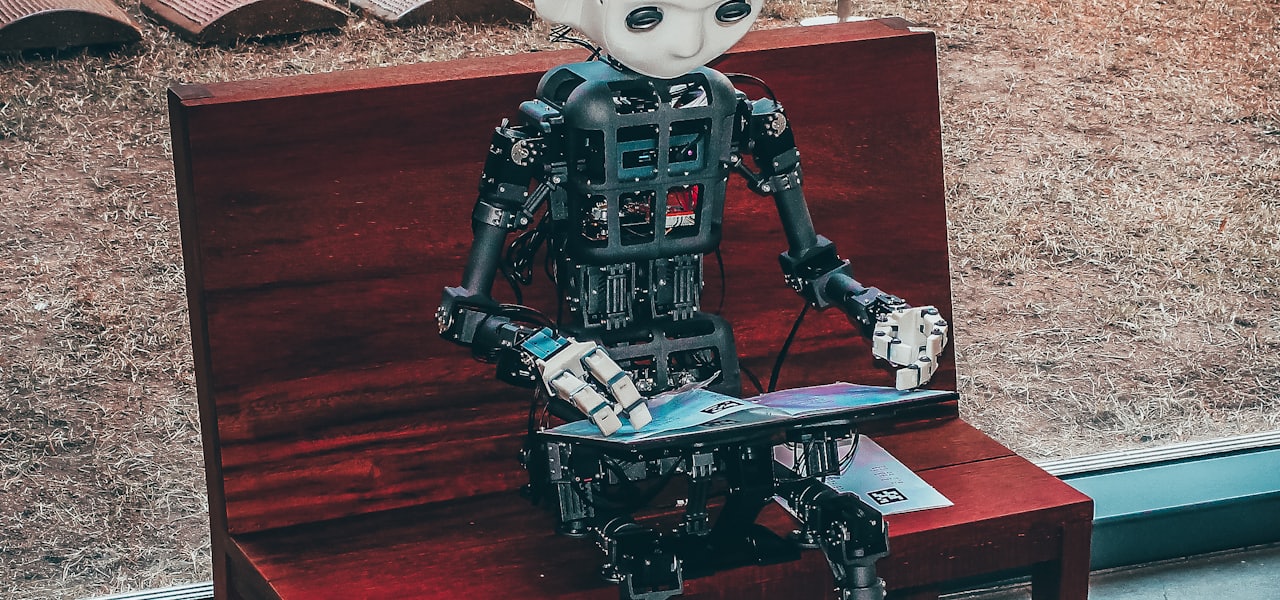
    Developmental robotics (DevRob), sometimes called epigenetic robotics, is a scientific field which aims at studying the developmental mechanisms, architectures and constraints that allow lifelong and open-ended learning of new skills and new knowledge in embodied machines. As in human children, learning is expected to be cumulative and of progressively increasing complexity, and to result from self-exploration of the world in combination with social interaction. The typical methodological approach consists in starting from theories of human and animal development elaborated in fields such as developmental psychology, neuroscience, developmental and evolutionary biology, and linguistics, then to formalize and implement them in robots, sometimes exploring extensions or variants of them. The experimentation of those models in robots allows researchers to confront them with reality, and as a consequence, developmental robotics also provides feedback and novel hypotheses on theories of human and animal development. Developmental robotics is related to but differs from evolutionary robotics (ER). ER uses populations of robots that evolve over time, whereas DevRob is interested in how the organization of a single robot's control system develops through experience, over time. DevRob is also related to work done in the domains of robotics and artificial life. == Background == Can a robot learn like a child? Can it learn a variety of new skills and new knowledge unspecified at design time and in a partially unknown and changing environment? How can it discover its body and its relationships with the physical and social environment? How can its cognitive capacities continuously develop without the intervention of an engineer once it is "out of the factory"? What can it learn through natural social interactions with humans? These are the questions at the center of developmental robotics. Alan Turing, as well as a number of other pioneers of cybernetics, already formulated those questions and the general approach in 1950, but it is only since the end of the 20th century that they began to be investigated systematically. Because the concept of adaptive intelligent machines is central to developmental robotics, it has relationships with fields such as artificial intelligence, machine learning, cognitive robotics or computational neuroscience. Yet, while it may reuse some of the techniques elaborated in these fields, it differs from them from many perspectives. It differs from classical artificial intelligence because it does not assume the capability of advanced symbolic reasoning and focuses on embodied and situated sensorimotor and social skills rather than on abstract symbolic problems. It differs from cognitive robotics because it focuses on the processes that allow the formation of cognitive capabilities rather than these capabilities themselves. It differs from computational neuroscience because it focuses on functional modeling of integrated architectures of development and learning. More generally, developmental robotics is uniquely characterized by the following three features: It targets task-independent architectures and learning mechanisms, i.e. the machine/robot has to be able to learn new tasks that are unknown by the engineer; It emphasizes open-ended development and lifelong learning, i.e. the capacity of an organism to acquire continuously novel skills. This should not be understood as a capacity for learning "anything" or even “everything”, but just that the set of skills that is acquired can be infinitely extended at least in some (not all) directions; The complexity of acquired knowledge and skills shall increase (and the increase be controlled) progressively. Developmental robotics emerged at the crossroads of several research communities including embodied artificial intelligence, enactive and dynamical systems cognitive science, connectionism. Starting from the essential idea that learning and development happen as the self-organized result of the dynamical interactions among brains, bodies and their physical and social environment, and trying to understand how this self-organization can be harnessed to provide task-independent lifelong learning of skills of increasing complexity, developmental robotics strongly interacts with fields such as developmental psychology, developmental and cognitive neuroscience, developmental biology (embryology), evolutionary biology, and cognitive linguistics. As many of the theories coming from these sciences are verbal and/or descriptive, this implies a crucial formalization and computational modeling activity in developmental robotics. These computational models are then not only used as ways to explore how to build more versatile and adaptive machines but also as a way to evaluate their coherence and possibly explore alternative explanations for understanding biological development. == Research directions == === Skill domains === Due to the general approach and methodology, developmental robotics projects typically focus on having robots develop the same types of skills as human infants. A first category that is important being investigated is the acquisition of sensorimotor skills. These include the discovery of one's own body, including its structure and dynamics such as hand-eye coordination, locomotion, and interaction with objects as well as tool use, with a particular focus on the discovery and learning of affordances. A second category of skills targeted by developmental robots are social and linguistic skills: the acquisition of simple social behavioural games such as turn-taking, coordinated interaction, lexicons, syntax and grammar, and the grounding of these linguistic skills into sensorimotor skills (sometimes referred as symbol grounding). In parallel, the acquisition of associated cognitive skills are being investigated such as the emergence of the self/non-self distinction, the development of attentional capabilities, of categorization systems and higher-level representations of affordances or social constructs, of the emergence of values, empathy, or theories of mind. === Mechanisms and constraints === The sensorimotor and social spaces in which humans and robot live are so large and complex that only a small part of potentially learnable skills can actually be explored and learnt within a life-time. Thus, mechanisms and constraints are necessary to guide developmental organisms in their development and control of the growth of complexity. There are several important families of these guiding mechanisms and constraints which are studied in developmental robotics, all inspired by human development: Motivational systems, generating internal reward signals that drive exploration and learning, which can be of two main types: extrinsic motivations push robots/organisms to maintain basic specific internal properties such as food and water level, physical integrity, or light (e.g. in phototropic systems); intrinsic motivations push robot to search for novelty, challenge, compression or learning progress per se, thus generating what is sometimes called curiosity-driven learning and exploration, or alternatively active learning and exploration; Social guidance: as humans learn a lot by interacting with their peers, developmental robotics investigates mechanisms that can allow robots to participate to human-like social interaction. By perceiving and interpreting social cues, this may allow robots both to learn from humans (through diverse means such as imitation, emulation, stimulus enhancement, demonstration, etc. ...) and to trigger natural human pedagogy. Thus, social acceptance of developmental robots is also investigated; Statistical inference biases and cumulative knowledge/skill reuse: biases characterizing both representations/encodings and inference mechanisms can typically allow considerable improvement of the efficiency of learning and are thus studied. Related to this, mechanisms allowing to infer new knowledge and acquire new skills by reusing previously learnt structures is also an essential field of study; The properties of embodiment, including geometry, materials, or innate motor primitives/synergies often encoded as dynamical systems, can considerably simplify the acquisition of sensorimotor or social skills, and is sometimes referred as morphological computation. The interaction of these constraints with other constraints is an important axis of investigation; Maturational constraints: In human infants, both the body and the neural system grow progressively, rather than being full-fledged already at birth. This implies, for example, that new degrees of freedom, as well as increases of the volume and resolution of available sensorimotor signals, may appear as learning and development unfold. Transposing these mechanisms in developmental robots, and understanding how it may hinder or on the contrary ease the acquisition of novel complex skills is a central questi

    Read more →
  • Deluxe Paint

    Deluxe Paint

    Deluxe Paint, often referred to as DPaint, is a bitmap graphics editor created by Dan Silva for Electronic Arts and published for the then-new Amiga 1000 in November 1985. A series of updated versions followed, some of which were ported to other platforms. An MS-DOS release with support for the 256 color VGA standard became popular for creating pixel graphics in video games in the 1990s. Author Dan Silva previously worked on the Cut & Paste word processor (1984), also from Electronic Arts. == History == Deluxe Paint began as an in-house art development tool called Prism. As author Dan Silva added features to Prism, it was developed as a showcase product to coincide with the Amiga's debut in 1985. Upon release, it was quickly embraced by the Amiga community and became the de facto graphics (and later animation) editor for the platform. Amiga manufacturer Commodore International later commissioned EA to create version 4.5 AGA to bundle with the new Advanced Graphics Architecture chipset (A1200, A4000) capable Amigas. Version 5 was the last release after Commodore's bankruptcy in 1994. Early versions of Deluxe Paint were available in protected and non copy-protected versions, the latter retailing for a slightly higher price. The copy protection scheme was later dropped. Deluxe Paint was first in a series of products from the Electronic Arts Tools group—then later moved to the ICE (for Interactivity, Creativity, and Education) group—which included such Amiga programs as Deluxe Music Construction Set (preceded by Music Construction Set for the Apple II), Deluxe Video, and the Studio series of paint programs for the Mac. With the development of Deluxe Paint, EA introduced the ILBM and ANIM file format standards for graphics. While widely used on the Amiga, these formats never gained widespread end user acceptance on other platforms, but were heavily used by game development companies. Deluxe Paint was used by LucasArts to make graphics for their adventure games such as The Secret of Monkey Island, and the name of a particular filename used to store the main protagonist Guybrush Threepwood was probably at the origin of his peculiar name. One of the main artist developer of the game, Mark Ferrari, in an interview for The Making of Monkey Island 30th Anniversary Documentary remembers that "there was a pulldown menu in DPaint called brushes, so character sprites were referred to as brushes", and the male protagonist was simply "the guy.brush" until the artist Steve Purcell suggested to take the very name "Guybrush". The author Ron Gilbert remembers that the PC DOS version of the file was named "guybrush.bbm". == Versions == === Amiga === Deluxe Paint I was released in 1985. A major feature was animation by using color cycling. The Amiga natively supports indexed color, where a pixel's color value does not carry any RGB hue information but instead is an index to a color palette (a collection of unique color values). By adjusting the color value in the palette, all pixels with that palette value change simultaneously in the image or animation, creating cyclic movement in the image. In the Christmas demo files on the Deluxe Paint I disk, this kind of animation (which is toggled by pressing the tab key) is used to depict falling snowflakes, a blinking Christmas tree, and a roaring fire in the fireplace. In 1986, Deluxe Paint II was introduced, which added many convenient features such as pattern and gradient fill, which could be selected by right-clicking on a fill tool. An effects menu with e.g. perspective transformation was also added. The screen format could now be changed from a dedicated selection page. Deluxe Paint III appeared in 1989 and added support for Extra Halfbrite. New editing modes allowed one to stencil certain colors to protect them, so it is possible to e.g. paint a landscape from front to back, with the foreground protected by a stencil. A major new feature of Deluxe Paint III was the ability to create cel-like animation, and animbrushes (1MB of RAM is needed for animation). These let the user pick up a section of an animation as an "animbrush", which can then be placed onto the canvas while it animates. Deluxe Paint III was one of the first paint programs to support animbrushes. This is similar to copy and paste, except one can pick up more than one image. Deluxe Paint IV (introduced in 1991), which did not include Silva as the lead programmer, offered significant new features like non-bitplane-indexed Hold-and-Modify support for creating images with up to 4,096 colors. Animation support was improved by adding a light table, i.e. onion skinning, and AnimBrush morphing. The color mixer was now a HAM region at the bottom of the screen (instead of a floating window as before) and allowed mixing adjacent colors similar to a real palette. Deluxe Paint 4.5 AGA appeared the following year, addressing the stability issues and providing support for the new A1200 and A4000 AGA machines and a revamped screen mode interface. It appeared in both standalone and Commodore-bundled versions. The final release, Deluxe Paint V, in 1995, supported true 24-bit RGB images. However, using only the AGA native chipset, the 24-bit RGB color was only held in computer memory, the on-screen image was displayed in HAM8 (18-bit color). === Apple IIGS === DeluxePaint II for the Apple IIGS was developed by Brent Iverson and released in 1987. === MS-DOS === Deluxe Paint II for MS-DOS was released in 1988, It required MS-DOS 2.0 and 640 kB of RAM. It supports CGA, EGA, MCGA, VGA, Hercules and Tandy IBM PC-compatible graphic cards. Deluxe Paint II Enhanced was released in 1989, requiring MS-DOS 2.11 and 640 kB of RAM. It supports resolutions up to 800x600 pixels with 256 colors. Deluxe Paint II Enhanced 2.0, released in 1994, was the most successful MS-DOS version, and was compatible with PC Paintbrush PCX image files. The MS-DOS conversion was done by Brent Iverson with the enhanced features by Steve Shaw. It supports CGA, EGA, MCGA, VGA, Hercules, Tandy, and Amstrad video cards, as well as early Super VGA video cards enabling it to support up to 800 × 600 with 256 (from 262,144) colors and 1024 × 768 with 16 colors. The sister product Deluxe Paint Animation (only for 320×200 pixels and 256 colors) was widely used, especially in video game development. === Atari ST === Deluxe Paint ST was developed by ArtisTech Development, published by Electronic Arts, and was released in 1990. It supports the Atari STE 4096 color palette and animated graphics. Features advertised for the Atari ST version include 3D perspective, design your own fonts, mirror symmetry, multi-color airbrushing & animations, printing up to poster size, split-screen magnification with variable zoom, and working on animations (including multiple animations). == Workflow == "[" and "]" hotkeys step through the indexed palette, turning indexed-pixel-painting into a fast two-handed mouse+keys process, and the right mouse button paints with the background color. For example, transparency is obtained as simply as selecting a background color index (a single right click on the palette GUI to change). colors could be locked from editing by use of a stencil (a list of color indices whose pixels should not be altered in the image data) and simple color-cycling animations could be created using contiguous entries in the palette. This was easy to change the hue and tone of a section of the image by altering the corresponding colors in the palette. (The specific section needed to use a dedicated part of the palette for this technique to work.) Brushes can be cut from the background by using the box, freehand, or polygon selection tools. They can then be used in the same manner as any other brush or pen. This functionality is simpler to use than the "stamp" tool of Photoshop or Alpha Channels as provided in later programs. Brushes can be rotated and scaled, even in 3D. After a brush is selected, it appears attached to the mouse cursor, providing an exact preview of what will be drawn. This allows precise pixel positioning of brushes. Animations stored in IFF ANIM format are delta compressed making animations both smaller and faster to playback. == Reception == Compute! criticized the documentation of the first release of DeluxePaint as inadequate, but stated that "DeluxePaint is a visual arts program of immense scope and flexibility". In later versions the documentation was much improved; for instance DeluxePaint IV came with a 300-page manual. Deluxe Paint was a hit for EA. The main line of the series, particularly installments one to three, has won a total of at least nine awards from independent publications and organizations, including three Amiga-specific awards. Deluxe Paint III also won Commodore International's Enterprise and Vision award in 1990, becoming the first software to win the award, for what the company's judges believed to be best utilizing the Amiga's graphical capabilities. Deluxe Pai

    Read more →
  • Color picker

    Color picker

    A color picker (also color chooser or color tool) is a graphical user interface widget, usually found within graphics software or online, used to select colors and, in some cases, to create color schemes (the color picker might be more sophisticated than the palette included with the program). Operating systems such as Microsoft Windows or macOS have a system color picker, which can be used by third-party programs (e.g., Adobe Photoshop). == History == The concept of color pickers dates back to the early days of computer graphics and digital design. Early versions were rudimentary, often featuring basic color palettes and limited functionality. One of the first drawing programs to include a color picker was SketchPad (also referred to as LisaSketch), designed by Bill Atkinson in 1983 to showcase LisaGraf's capabilities. It used a black and white pattern system, using dithering to create the illusion of color depth. With the increased popularity of personal computers with color graphics, there soon came software similar to SketchPad that supported more than two colors, like Broderbund's Dazzle Draw for the Apple II or Electronic Arts' Deluxe Paint. However, the color pickers present in those programs relied on indexed colors. Color pickers, resembling ones used in modern software with support for direct, 24-bit color, appeared soon after the release of the Macintosh II, with the release of programs like Adobe Photoshop and Corel Painter. As the increase of color depth allowed the choice of significantly more colors, the shape and form of color pickers started to diverge. For example, Adobe Photoshop used a hue-saturation color wheel with a slider for brightness in version 0.63, later on switching to a rectangular design accompanied by a hue slider. Corel Painter pioneered the triangular saturation and brightness picker with a hue ring around it, aiming to better represent the continuity of the hue spectrum and the relationship between saturation and brightness. == Purpose == A color picker is used to select and adjust color values. In graphic design and image editing, users typically choose colors via an interface with a visual representation of a color—organized with quasi-perceptually-relevant hue, saturation and lightness dimensions (HSL) – instead of keying in alphanumeric text values. Because color appearance depends on comparison of neighboring colors (see color vision), many interfaces attempt to clarify the relationships between colors. == Interface == Color tools can vary in their interface. Some may use sliders, buttons, text boxes for color values, or direct manipulation. Often a two-dimensional square is used to create a range of color values (such as lightness and saturation) that can be clicked on or selected in some other manner. Drag and drop, color droppers, and various other forms of interfaces are commonly used as well. Usually, color values are also displayed numerically, so they can be precisely remembered and keyed-in later, such as three values of 0-255 representing red, green, and blue, respectively. === Eyedropper === The eyedropper is a tool present in most color pickers and graphics software that allows a user to read a color at a specific point in an image, or position on a display. This enables the color to be transferred to other applications particularly quickly. Modern implementations of eyedropper tools are also available as browser extensions, allowing users to pick colors directly from web pages, such as in Google Chrome and Microsoft Edge. == Working == A color picker has two main parts, first a color slider and second a color canvas. The color slider has a linear or radial gradient of the seven rainbow colors i.e. Violet, Indigo, Blue, Green, Yellow, Orange and Red. It allows one to choose any of the seven primary colors. The color value chosen from the color slider instantly reflects in the color canvas. The color canvas is a mixture of two linear color gradients. First a linear gradient of the current chosen color and second a linear gradient of the black color. This mixture of color gradients lets one choose a lighter and darker version of the current chosen color from the color slider.

    Read more →
  • Productivity software

    Productivity software

    Productivity software (also called personal productivity software or office productivity software) is application software used for producing information (such as documents, presentations, worksheets, databases, charts, graphs, digital paintings, electronic music and digital video). Its names arose from it increasing productivity, especially of individual office workers, from typists to knowledge workers, although its scope is now wider than that. Office suites, which brought word processing, spreadsheet, and relational database programs to the desktop in the 1980s, are the core example of productivity software. They revolutionized the office with the magnitude of the productivity increase they brought as compared with the pre-1980s office environments of typewriters, paper filing, and handwritten lists and ledgers. In the United States, as of 2015, some 78% of "middle-skill" occupations (those that call for more than a high school diploma but less than a bachelor's degree) required the use of productivity software. == Details == Productivity software traditionally runs directly on a computer. For example, Plus/4 model of computer contains in ROM for applications of productivity software. Productivity software is one of the reasons people use personal computers. == Office suite == An office suite is a bundle of productivity software (a software suite) intended to be used by office workers. The components are generally distributed together, have a consistent user interface and usually can interact with each other, sometimes in ways that the operating system would not normally allow. The earliest office suite for personal computers was MicroPro International's StarBurst in the early 1980s, comprising the WordStar word processor, the CalcStar spreadsheet and the DataStar database software. Other suites arose in the 1980s, and Microsoft Office came to dominate the market in the 1990s, a position it retains as of 2024. During the 1990s, office suite products gained popularity by offering bundles of applications that, when bought as part of a suite, effectively discounted the individual applications, with four or five applications being bundled for the price of two applications bought separately. When faced with such potential savings, customers could be "tempted by the suite, rather than the value of a particular product", and by 1994 more than 60 percent of the sales of Microsoft Word and around 70 percent of the sales of Microsoft Excel were as part of sales of Microsoft Office. Such considerations had an impact on vendors of individual applications, often smaller companies, raising concerns that office suites were "stifling innovation", and even established vendors such as Borland and WordPerfect were having to adapt to the suite phenomenon, Borland ultimately deciding to sell its Quattro Pro spreadsheet to WordPerfect as the latter sought to assemble its own suite product. The dominant suite vendors, Microsoft and Lotus, downplayed competition and innovation concerns, claiming that users were still able to exercise choice and that "user-driven development" was guiding the evolution of office suites. Another view was that component-based software would eventually emerge, focusing development on more specialised components used by productivity software, empowering "a plethora of third-party developers", and that a "mix and match" approach of such components would adapt to the user's way of working. === Office suite components === The base components of office suites are: Word processor Spreadsheet Presentation program Other components include: Database software Graphics suite (raster graphics editor, vector graphics editor, image viewer) Desktop publishing software Formula editor Diagramming software Email client Communication software Personal information manager Notetaking Groupware Project management software Table (information) Web log analysis software

    Read more →
  • N-jet

    N-jet

    An N-jet is the set of (partial) derivatives of a function f ( x ) {\displaystyle f(x)} up to order N. Specifically, in the area of computer vision, the N-jet is usually computed from a scale space representation L {\displaystyle L} of the input image f ( x , y ) {\displaystyle f(x,y)} , and the partial derivatives of L {\displaystyle L} are used as a basis for expressing various types of visual modules. For example, algorithms for tasks such as feature detection, feature classification, stereo matching, tracking and object recognition can be expressed in terms of N-jets computed at one or several scales in scale space.

    Read more →
  • Super app

    Super app

    A super app or super-app (also known as an everything app) is a mobile or web application that can provide multiple services including payment and instant messaging services, effectively becoming an all-encompassing, self-contained, commerce and communication online platform that embraces many aspects of personal and commercial life. Notable examples of super apps include Tencent's WeChat in China, Tata Neu in India, Grab in Southeast Asia and Max in Russia. For end users, a super app is an application that provides a set of core features while also giving access to independently developed miniapps. For app developers, a super app is an application integrated with the capabilities of platforms and ecosystems that allows third-parties to develop and publish miniapps. == History == The super app term was first used to describe WeChat when it combined the instant messaging service with the digital wallet function. Recognition of WeChat as a super app stems from its combination of messaging, payments, e-commerce, and much more within a single application, making it indispensable for many users. WeChat's establishment of the super app model has led companies like Meta to try to build similar applications outside of China. In India, Tata Group has announced that it is currently developing a super app named Tata Neu. Major Indian companies like Paytm, PhonePe, and ITC Maars also have apps in development that might constitute super apps. In Southeast Asia, Grab and Gojek lay claim to the super app classification despite lacking many of the features offered by WeChat. Accordingly, growth-stage companies like Shopee, Traveloka, and AirAsia have also expanded the range of services offered by their respective applications. == Notable examples == === Alipay === Alipay is a third-party mobile and online payment platform established in Hangzhou, China in February 2004 by Alibaba Group and its founder Jack Ma. It operates in association with Ant Group, an affiliate company of the Chinese Alibaba Group. === Gojek === Gojek is an Indonesian on-demand multiservice digital platform and fintech payment super app. Established in Jakarta in 2010, as a call center to connect consumers to courier delivery and two-wheeled ride-hailing services, it launched its mobile app in 2015 with four services: GoRide, GoSend, GoShop, and GoFood, which has since expanded to offer over 20 services. In 2021, it merged with another Indonesian unicorn, Tokopedia, forming the decacorn GoTo Gojek Tokopedia. === Grab === Grab is a Southeast Asian technology company headquartered in Singapore and Indonesia. Founded in 2012 as the MyTeksi app in Kuala Lumpur, Malaysia, it expanded the following year as GrabTaxi, before moving its headquarters to Singapore in 2014 and rebranding officially as Grab. In addition to ride-hailing and transportation services, the company's mobile app also offers food delivery and digital payment services. === Max === Max is a messenger from the Russian company VK, positioned as a super app. The application combines messaging, calls, and channels features with the integration of additional services: payments, miniapps, taxi ordering, deliveries, and other everyday services are available within a single interface. The goal is to unite communication and routine tasks in a unified ecosystem. === Tata Neu === Tata Neu is a multipurpose super app, developed in India by the Tata Group. It is the country's first super app. The app was launched to coincide with the start of a 2022 Indian Premier League cricket match. === WeChat === WeChat is a Chinese multipurpose instant messaging, social media and mobile payment app. First released in 2011, it became the world's largest standalone mobile app in 2018, with over 1 billion monthly active users. WeChat provides text messaging, hold-to-talk voice messaging, broadcast (one-to-many) messaging, video conferencing, video games, the sharing of photographs and videos and location sharing. === X === X is an American social network, originally known as Twitter from its launch through 2023. Prior to his acquisition of the service, new owner Elon Musk stated that he planned for Twitter to become an "everything app" known as "X"; in 2023, the service added an AI chatbot known as "Grok" as well as integrated job search tools known as "X Hiring". In January 2025, X announced its intent to offer a digital wallet service in the future. Later in the year, X revamped its direct messaging system as "Chat". == Criticism == Although apps that fit the super app classification can offer users a wider variety of services in comparison to single-purpose alternatives, internet regulators in regions such as the US and Europe have become more concerned about the overall power of the technology industry and have become more critical of companies developing such apps. In China, WeChat and other local firms have been ordered to open up their platforms to rivals by local regulators. There are also reports that suggest it might be difficult to replicate WeChat's super app model. This stems partly from the peaking of smartphone penetration rates in many regions worldwide, which has led to overcrowded app stores and tighter restrictions on targeted advertising as regulators assert more control over the companies. From a technical viewpoint, single-purpose apps are comparatively faster, more responsive and easier to navigate than super apps, which helps improve the overall user experience. Super-apps are also likelier to store larger amounts of personal data to facilitate the delivery of their services, so users run a greater risk of becoming victims of severe data breaches. In 2020, this unfolded with Tokopedia, which had the data of 91 million of its users stolen and shared by crackers. It has also been noted that a user who loses access to their account or is banned from a super app generally loses access to multiple real-life services and digital applications; the Chinese government has used this approach to penalize people who shared the photos of the Sitong Bridge protest.

    Read more →
  • Paint.NET

    Paint.NET

    Paint.NET (sometimes stylized as paint.net) is a freeware general-purpose raster graphics editor program for Microsoft Windows, developed with the .NET platform. Paint.NET was originally created by Rick Brewster as a Washington State University student project, and has evolved from a simple replacement for the Microsoft Paint program into a program for editing mainly graphics, with support for plugins. == History == Paint.NET originated as a computer science senior design project by Rick Brewster during spring 2004 at Washington State University. Version 1.0 consisted of 36,000 lines of code and was written in four months. In contrast, version 3.35 has approximately 162,000 lines of code. The Paint.NET project continued over the summer and into the autumn 2004 semester for both the version 1.1 and 2.0 releases. Development continued with one programmer who worked on previous versions of Paint.NET while he was a student at WSU. As of May 2006 the program had been downloaded at least 2 million times, at a rate of about 180,000 per month. Initially, Paint.NET was released under a modified version of the MIT License, with the exclusion of the installer, text, and graphics. However, citing issues with the open source code being plagiarized by others that had rebranded the software as their own and bundled user content without their permission, the availability of the source code was restricted, in December 2007 Brewster announced his intent to restrict access to components of the program (including its installer, resources, and user interface). In November 2009, the software was made proprietary, restricting the sale or creation of derivative works of the software. Starting with version 4.0.18, Paint.NET is published in two editions: A classic edition remains freeware, similar to all other versions since 3.5. Another edition, however, is published to Microsoft Store under a trialware license and is available to purchase for US$14.99. According to the developer, this was done to enable the users to contribute to the development with more convenience, even though the old avenue of donation was not closed. In May 2026, Brewster revealed that he obtained the paint.net domain after attempting to do so for 22 years. Historically, the editor was hosted on getpaint.net, and according to Brewster, the previous owners of paint.net would not sell the domain and asked for "lots and lots of money". In December of the previous year, paint.net began hosting content that impersonated Paint.NET, therefore becoming a clear case of trademark infringement and domain squatting. Brewster stated that he was able to obtain the domain afterwards with the help of a lawyer. == Overview == Paint.NET is primarily programmed in the C# programming language. Its native image format, .PDN, is a compressed representation of the application's internal object format, which preserves layering and other information. == Plugins == Paint.NET supports plugins, which add image adjustments, effects, and support for additional file types. They can be programmed using any .NET Framework programming language, though they are most commonly written in C#. These are created by volunteer coders on the program's discussion board, the Paint.NET Forum. Though most are simply published via the discussion board, some have been included with a later release of the program. For instance, a DirectDraw Surface file type plugin, (originally by Dean Ashton) and an Ink Sketch and Soften Portrait effect (originally by David Issel) were added to Paint.NET in version 3.10. Hundreds of plugins have been produced; such as Shape3D, which renders a 2D drawing into a 3D shape. Some plugins expand on the functionality that comes with Paint.NET, such as Curves+ and Sharpen+, which extend the included tools Curves and Sharpen, respectively. Examples of file type plugins include an Animated Cursor and Icon plugin and an Adobe Photoshop file format plugin. Several of these plugins are based on existing open source software, such as a raw image format plugin that uses dcraw and a PNG optimization plugin that uses OptiPNG. == Forks == === paint-mono === Paint.NET was created exclusively for Windows and has no native support for other operating systems. Due to its former open-source licensing, the development of alternative versions was possible. In May 2007, Miguel de Icaza officially started a porting project called paint-mono. This project had partially ported Paint.NET 3.0 to Mono, an open-source implementation of the Common Language Infrastructure on which the .NET Framework is based. This allowed Paint.NET to be run on Mono-supported platforms, such as Linux. This port is no longer maintained and has not been updated since March 2009. Newer Mono runtime 6 versions are able to run original Paint.NET releases up to 3.5.11 with only minor issues. === Pinta === In 2010, developer Jonathan Pobst started a project called Pinta, describing it as a clone of Paint.NET for Mono and Gtk#. Pinta reused the adjustments and effects code from Paint.NET but otherwise is original code.

    Read more →